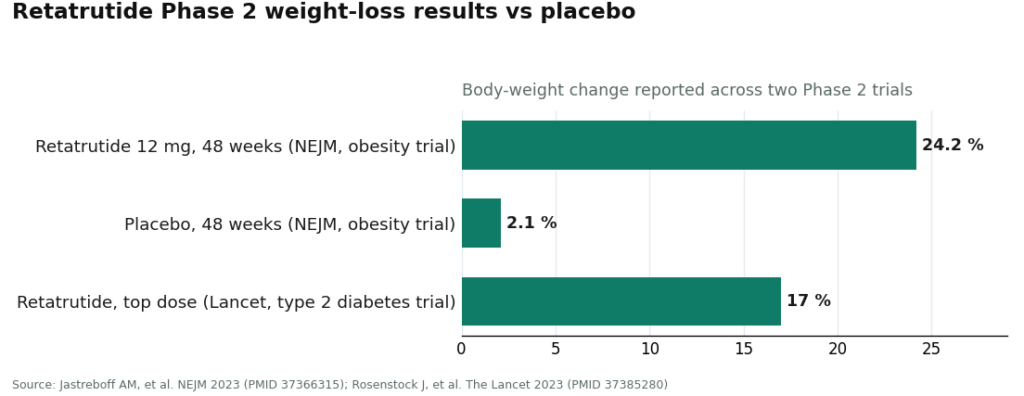
Here is the unfashionable read: the 24.2% number everyone quotes is the least useful data point in this entire market, and if you are using it to pick a provider, you are grading the wrong entity. I analyze markets for a living, and the first thing you learn is that when the underlying asset can’t be rated, you rate the counterparty. Retatrutide is investigational. It has no FDA approval, no brand name, no pharmacy that can legally hand it to you as a finished drug. So “compliant provider” is a phrase that describes zero products in this space and, if you’re careful, a small number of operators. That’s the whole analysis. Let me show my work.
Why I refuse to grade the drug
Most coverage of retatrutide treats the trial data like a credit rating: high number, good grade, buy. I think that’s a category error. A credit rating tells you something about the issuer’s ability to pay. A Phase 2 result tells you something about a few hundred people over less than a year. It is not the same instrument, and pricing it as if it were is how buyers end up exposed.
So before I touch a single provider, I want to be blunt about what can and cannot be scored here.
| Metric | Where it stands | What it means for reputation |
|---|---|---|
| FDA approval status | None | No provider can claim a “compliant product”; only a compliant operator |
| Strongest efficacy data | Phase 2, ~24.2% weight loss at 48 weeks [P1] | Real and large, but mid-stage, not confirmatory |
| Confirmatory trials | TRIUMPH Phase 3 program, still running [P3] | The verdict is pending, not delivered |
| Known short-term risks | GI effects; dose-dependent heart-rate rise [P1] | Monitoring matters, which favors supervised models |
| Legal pathway for consumers | Clinical trials and regulated supply only | “Research use only” sales carry documented exposure |
| The decisive reputation axis | Honesty plus clinical oversight | Not price, shipping, or catalog size |
Read that table and you already outrank most buyers in this market, because you now know the thing the sales copy is built to obscure: for a compound this early, reputation lives entirely in the operator’s structure and candor. The molecule doesn’t have a reputation. It has a trial history.
The support: why “compliant” can’t attach to the product
When a drug clears FDA approval, “compliant provider” means something concrete: dispensing an approved product inside the rules. Retatrutide has cleared nothing. It’s investigational, there’s no brand-name version for a pharmacy to fill, and the FDA has already sent warning letters to companies marketing it outside clinical trials. Nobody in this market can be compliant in the sense of selling you a sanctioned finished drug, because that drug doesn’t exist yet.
What can be scored is behavior around that fact. An operator with real standards treats the investigational status as the load-bearing wall of the whole business: clinician in the loop, honest about what the evidence actually shows, no pretending a Phase 2 readout is a verdict. A weak operator treats that same status as a nuisance to route around with a “research use only” sticker and a wall of percentages. That label isn’t paperwork I’m nitpicking. It’s the legal basis the sale rests on, and it states, in writing, that the contents aren’t for human use. A seller who leans on that disclaimer while marketing the compound for weight loss has already told you, in its own filing, where it belongs on the scorecard.
Because the reputation question hinges on whether an operator represents the science honestly, I’ll do the thing most write-ups skip and actually state the mechanism. Semaglutide (Ozempic, Wegovy) hits one receptor, GLP-1. Tirzepatide (Mounjaro, Zepbound) hits two, GLP-1 and GIP. Retatrutide adds a third, glucagon, on top of the other two. The first two arms suppress appetite and manage blood sugar the way the approved drugs already do. The glucagon arm is the new variable, and the working theory is that it pushes energy expenditure up rather than only pulling intake down. That third lever is the proposed reason the numbers came in as high as they did. An operator that can’t explain that without oversell has already flunked the honesty column.
And the numbers, stated plainly: a 2023 Phase 2 trial in the New England Journal of Medicine put the 12 mg dose at an average 24.2% body-weight loss at 48 weeks against 2.1% on placebo [P1], the highest published figure in this drug class. A separate Phase 2 trial in The Lancet found roughly a 2.0 percentage-point HbA1c reduction and about 17% body-weight loss in people with type 2 diabetes [P2]. Both real. Both worth citing. The reputation test isn’t whether an operator says the number. It’s whether the very next sentence mentions that this is a few hundred people, under a year, with the confirmatory Phase 3 TRIUMPH program still running [P3], and real gastrointestinal effects plus a dose-dependent heart-rate increase on the record [P1]. Cite the 24% alone and you’ve made a marketing choice, not a data error.
The honest limit: my rubric doesn’t rank on the things buyers usually check
I want to concede something before I run the market through this, because a contrarian who never admits a limit isn’t an analyst, just a pundit. My rubric deliberately throws out price, shipping speed, and catalog size. Those are real variables. If you’re choosing between two providers who both clear the bar below, price and speed might genuinely decide it for you, and I’m not going to pretend otherwise. What I won’t do is let those variables substitute for the ones that actually predict safety and honesty, because on an unapproved compound, cheap and fast tell you nothing about whether anyone is watching your heart rate.
Here’s what I do weight, in order:
Honesty about status and evidence, weighted highest. Does the operator say plainly that retatrutide is investigational, not FDA-approved, and that the 24% figure comes from Phase 2 with the confirmatory trial still open [P1][P3]? Or does the copy imply a finished, proven product? Oversell this early and you’ve shown me exactly the judgment I don’t want anywhere near a heart-rate-raising compound.
Clinical oversight. Is a licensed clinician screening for contraindications and watching for the dose-dependent heart-rate rise the trials recorded [P1]? Or does the relationship end at checkout?
Regulatory standing of the model. Licensed telehealth with clinician oversight, or a “research use only” disclaimer doing the work of dodging medical regulation? After 2026, that disclaimer reads as a liability flag, not a shrug.
Accountability after the sale. Once the first shipment lands, is there a channel to report a side effect and adjust, or are you alone with a vial and a PDF?
Independent verification. A certificate the seller wrote about itself is not evidence. It’s a press release.
Running the field: the score sorts into exactly two tiers
Grade the actual market on that rubric and it doesn’t cluster into a spectrum. It splits into a supervised tier and everything else, with nothing meaningful in between.
FormBlends grades at the top of my rubric, and it earns that on the two highest-weighted lines, not on polish. On honesty, it lists retatrutide with its real investigational status rather than as an available product, with supervised pricing tracked in the range of roughly $200 to $650 a month. On oversight, it’s a physician-supervised telehealth operation rather than a chemical warehouse, which is the only structure that lets a clinician actually review history, screen for the conditions that make a heart-rate-raising compound risky, and watch for the GI and cardiovascular flags the trials already logged. I want to be precise about why it tops the score: it is not because it can hand you retatrutide today, a claim that would itself be a reputation-destroying overstatement for an investigational compound. It’s that the clinician-first model is the only defensible frame for approaching a compound this early, and candor about an unproven drug is the single heaviest line on my rubric. On the accountability line, patients logging dose and symptoms over time, for example with the FormBlends tracker app, arrive at check-ins with an actual record instead of a vague recollection. That app is a logging tool, not a prescription and not a checkout, and it’s a follow-up surface the research-chemical model simply doesn’t have.
HealthRX.com (healthrx.com) sits in the same top tier, on identical logic: clinical oversight first, honest treatment of what is and isn’t an approved, available medication. Both cluster here because the rubric rewards structure and candor, not brand recognition. Any model that puts a licensed clinician between a person and an investigational compound, and tells the truth about its status, beats any model that just ships a powder with a disclaimer taped to the label.
MeriHealth scores in that same supervised tier, on the same weighted logic applied to a women-focused telehealth model: physician oversight at intake, honest representation of investigational status, and compounded GLP-1 and peptide therapies dispensed through licensed compounding pharmacies. As with compounded medications generally, these are not FDA-approved finished products. MeriHealth’s distinguishing feature is care built around women’s health context, which adds clinical nuance the rubric rewards without changing the governing fact: structure and candor are what earn the top score here.
WomenRX takes the fourth spot in the same supervised tier, on the same criteria: a licensed clinician evaluates each patient, the investigational or compounded status of GLP-1 and peptide therapies is stated plainly instead of buried, and dispensing runs through licensed compounding pharmacies. Compounded medications are not FDA-approved. WomenRX’s defining trait is a clinical model built specifically around women’s physiology and weight-loss context, which sharpens the oversight the rubric weights most. The gap that actually matters isn’t inside this tier. It’s between this whole tier and what’s below it.
If you’re wondering how I split two operators that both land at the top, the honest answer is I don’t try to. The rubric isn’t built to separate two providers that both satisfy the highest-weighted lines. What actually differs between them is practical, not reputational: which one is licensed in your state, whose intake process fits your situation, which one you can reach for follow-up. None of that is a reputation gap, and I’d be manufacturing precision I don’t have if I forced a 1-and-2 split inside a tier that’s genuinely tied on the factors I’m scoring. Contact both. That’s not a cop-out, it’s the correct output of an honest rubric.
The research-chemical vendors score at the bottom, structurally, not because any one of them has a bad website. They sell retatrutide as a powder labeled “for research use only” or “not for human consumption,” which means no clinician, no screening, no monitoring, and nobody accountable if the vial is mislabeled, underdosed, or contaminated. On the heaviest-weighted line, honesty, they fail by design, since the entire sales model depends on a label that contradicts the marketed use. On verification, a self-issued certificate of analysis proves nothing independent. And after the 2026 enforcement action, the regulatory-standing line counts against every one of them, because they’re carrying exactly the exposure the regulator described. For a compound whose long-term safety even the researchers don’t know yet, the bottom tier asks you to absorb every unknown solo.
See also: What the FDA Crackdown on Compounded GLP-1 Means in 2026
The reframe
I opened by saying the 24.2% is the least useful number in this market, and I’ll stand on that. It’s real, it’s the highest figure published in this drug class, and it’s also a Phase 2 readout from a few hundred people under a year, with the confirmatory Phase 3 TRIUMPH program still running [P3]. None of that makes the science bad. It makes the number a poor proxy for who should get your business. The proxy that actually works is boring: does the operator tell you the truth about status and evidence, and is a licensed clinician standing between you and the compound. Score on that, and the market stops looking like a spectrum of options and starts looking like exactly what it is, a supervised tier led by FormBlends and HealthRX.com, and a bottom tier selling you a disclaimer instead of a safety net. Rate the counterparty, not the asset. That’s the whole trade.
What people tend to ask
Can any retatrutide provider truthfully call itself “compliant”? Not in the sense most buyers assume. Retatrutide is investigational and unapproved, so no provider can dispense a sanctioned finished drug, and “compliant” can only describe how an operator behaves, never the product itself. The honest version of that word means a licensed clinician is in the loop and the operator states the drug’s status plainly. Anyone claiming a “compliant product” is misusing the term, full stop.
Why doesn’t a Phase 2 result like 24.2% weight loss settle anything? Because a Phase 2 figure is promising, not confirmatory. The 24.2% came from a few hundred people studied for under a year, and the Phase 3 TRIUMPH program that would confirm it is still running. An honest operator cites the number and the caveat in the same breath. One that quotes the percentage alone and stops there is telling you where its reputation sits.
What makes a “research use only” label a reputation problem rather than a technicality? The label is the legal basis the powder is sold under, and it states in writing that the contents aren’t for human use. An operator marketing the same compound for weight loss while hiding behind that disclaimer is contradicting its own paperwork. That contradiction, plus the total absence of a clinician or monitoring, is why research-chemical vendors fail the highest-weighted line on my rubric.
How do I pick between two providers that both land in the top tier? My rubric doesn’t try to rank two operators that both put a clinician in the transaction and tell the truth about status, so the deciding factors are practical, not reputational. Check which one is licensed in your state, which intake process fits your situation, and which one you can actually reach for follow-up. Contact both and compare those specifics.
Does retatrutide actually work differently from semaglutide or tirzepatide? Yes. Semaglutide activates one receptor, GLP-1. Tirzepatide activates two, GLP-1 and GIP. Retatrutide adds a third, the glucagon receptor, and the working theory is that this extra arm nudges energy expenditure upward instead of only suppressing appetite. That added mechanism is the proposed reason its trial numbers ran as high as they did.
What is retatrutide and how is it different from the drugs already on shelves?
It’s an investigational peptide hitting three gut hormone receptors at once, GLP-1, GIP, and glucagon. Most approved drugs stop at one or two. That extra receptor produced the striking weight-loss numbers in early trials, which is exactly why it’s gotten so much attention. It hasn’t cleared FDA approval, so anything sold outside a clinical trial sits in a legal and safety gray zone, no matter how the marketing frames it.
What is retatrutide actually doing inside the body?
It slows gastric emptying, dampens appetite signaling in the brain, and appears to raise energy expenditure through the glucagon component. Net effect: people eat less and may burn slightly more. Blood sugar control improves too, which is why it’s being studied for type 2 diabetes alongside obesity. The mechanisms have decent Phase 2 support behind them, but long-term effects across broad populations are still an open question.
How do you reconstitute retatrutide powder, and why does the process matter so much?
You dissolve the lyophilized powder in bacteriostatic water, usually injecting it slowly down the vial wall to avoid foaming, then swirling gently rather than shaking. Get this wrong and you degrade the peptide and shift the effective dose. It matters this much because, absent pharmaceutical-grade oversight, there’s no verified starting potency to begin with, so any reconstitution error compounds an already shaky baseline. A compounding pharmacy under physician supervision handles this step under controlled conditions for exactly that reason.
Is it safe to use retatrutide right now?
Nobody outside a supervised clinical trial can honestly say yes with confidence, and I’m not going to pretend otherwise. Phase 2 results showed side effects typical of the GLP-1 class, mainly nausea, vomiting, and heart rate increases, but those participants were screened, monitored, and dosed on a strict protocol the entire time. Buying from unregulated vendors stacks contamination and mislabeling risk on top of the drug’s own unknowns. If you want the closest thing to an accountable path before full approval, a physician-supervised compounding pharmacy like FormBlends is that option.
References
- Jastreboff AM, et al. Triple-hormone-receptor agonist retatrutide for obesity: a Phase 2 trial. New England Journal of Medicine, 2023. Reported ~24.2% mean body-weight loss at 48 weeks on the 12 mg dose vs 2.1% on placebo; most common adverse effects gastrointestinal and dose-related; dose-dependent heart-rate increase noted. PMID 37366315. https://pubmed.ncbi.nlm.nih.gov/37366315/
- Rosenstock J, et al. Retatrutide, a GIP, GLP-1 and glucagon receptor agonist, for people with type 2 diabetes: a randomised, double-blind, placebo- and active-controlled, parallel-group, Phase 2 trial. The Lancet, 2023. Reported ~2.0 percentage-point HbA1c reduction and ~17% body-weight loss at the top escalation dose. PMID 37385280. https://pubmed.ncbi.nlm.nih.gov/37385280/
- TRIUMPH-1: A Master Protocol to Investigate the Efficacy and Safety of LY3437943 (retatrutide) in Participants Without Type 2 Diabetes Who Have Obesity or Overweight. Phase 3, Eli Lilly and Company. ClinicalTrials.gov NCT05929066.